New Mexico Health and Health Care in 2050 by Nandini Pillai Kuehn Fred Harris
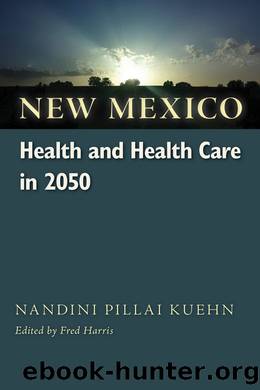
Author:Nandini Pillai Kuehn, Fred Harris [Nandini Pillai Kuehn, Fred Harris]
Language: eng
Format: epub
Tags: History, United States, State & Local, Southwest (AZ; NM; OK; TX), Political Science, Public Policy, General
ISBN: 9780826356123
Google: 8MEnCgAAQBAJ
Publisher: UNM Press
Published: 2015-07-01T02:52:49+00:00
These crucibles of experimentation with near-universal health coverage will be the ACAâs most valuable contribution to reducing fragmentation in our health care system; such changes will reduce administrative costs, because each different coverage system has made different administrative demands on providers. These experimental crucibles will be formally recognized and will be either copied or adapted from different parts of the country to meet local needs.
If the changes set in motion through the ACA are enhanced and supported during the next decade, by 2050 the country can expect to have a system that will have dramatically turned the cost curve by introducing low-cost, effective care that is evidence based and outcomes driven for all populations.
Also, if we leave the ACA to do its work, a system may develop that is more in line with âthe American wayââthat is, a blend of local structures and solutions with the common theme of care integrated across systems. There will be a âfree-marketâ component; the act will make public programs more efficient and accountable and therefore ensure their survival. And it will provide a role for commercial plans that leave them independent yet regulated enough to deliver good health care outcomes as their core business. We could have an equilibrium of sorts that is uniquely American.
Scenario 2: Parts of the ACA Are Retained but Different Change Agents Are Introduced, Leading to a Different Model of Universal Coverage
Under this scenario, sometime between now and 2050 there will be additional tinkering with ACA-introduced structures that will insert different political priorities for funding and maintaining our health system. Certain components of the ACA will be implemented fully, but there is the risk of losing others to politics or capacity issues. It is also possible that under this scenario, with fewer regulatory aspects of the ACA in place, more components of the health system will be likely to collide or collapse, leading to a crisis that eventually will require dramatic changes in our health system. The shape of the resulting health system could depend on how much of the ACA gets derailed. This will be a more turbulent scenario, but in the end, it is likely to provide universal coverage as well because high numbers of uninsured are a drag on the economy.
Whatever the changes contemplated in this scenario, new policies will stop short of reintroducing the more egregious flaws of the earlier health insurance system. However, proponents will look at introducing more âmarket forcesâ that may be seen as generating cost savings.
There are some changes that could occur in the short term and continue for the near future under this scenario:
Make health insurance exchanges much more like website sales enterprises. Exchanges will be limited to hosting plans and providing a vehicle for enrolling individuals; they will not act as value-based purchasers of affordable, high-value plans. The exchanges will not have a role in shaping coverage benefits or reporting on quality and costs, so the battle over how to control costs could last longer.
Exceptions will likely be made to
Download
This site does not store any files on its server. We only index and link to content provided by other sites. Please contact the content providers to delete copyright contents if any and email us, we'll remove relevant links or contents immediately.
The Vikings: Conquering England, France, and Ireland by Wernick Robert(84417)
Ali Pasha, Lion of Ioannina by Eugenia Russell & Eugenia Russell(40333)
The Conquerors (The Winning of America Series Book 3) by Eckert Allan W(38004)
The Vikings: Discoverers of a New World by Wernick Robert(37023)
Cecilia; Or, Memoirs of an Heiress — Volume 1 by Fanny Burney(32653)
Cecilia; Or, Memoirs of an Heiress — Volume 2 by Fanny Burney(32021)
Cecilia; Or, Memoirs of an Heiress — Volume 3 by Fanny Burney(32004)
Empire of the Sikhs by Patwant Singh(23146)
The Secret History by Donna Tartt(19352)
Hans Sturm: A Soldier's Odyssey on the Eastern Front by Gordon Williamson(18664)
Cat's cradle by Kurt Vonnegut(15466)
Pimp by Iceberg Slim(14708)
Sapiens: A Brief History of Humankind by Yuval Noah Harari(14477)
Norse Mythology by Gaiman Neil(13470)
Talking to Strangers by Malcolm Gladwell(13469)
Leonardo da Vinci by Walter Isaacson(13424)
4 3 2 1: A Novel by Paul Auster(12539)
Underground: A Human History of the Worlds Beneath Our Feet by Will Hunt(12170)
The Radium Girls by Kate Moore(12110)
